Table of Contents
As a local business owner, you must have googled a name of a competitor at least once to know what he/she is doing. This thought process is totally valid, and this is what digital marketing competitor analysis is all about. It is about analyzing how your competitors are presenting themselves online and leveraging the information to develop an even better marketing plan.
I am a freelancer digital marketing analyst working from Kochi, and conducting digital marketing competitor analysis for a local business is the very first thing that I do for any business. It is not about copying or stealing; rather, it is about understanding the industry you are competing in, so that you are not making decisions in vacuum anymore.
In this article, I will guide you through everything about digital marketing competitor analysis– the process that I follow, an example of competitor analysis from a local business of Kochi, one of the mistakes that every businessman makes, and a tip that everyone should carry forward from this article.
What Is Digital Marketing Competitor Analysis?
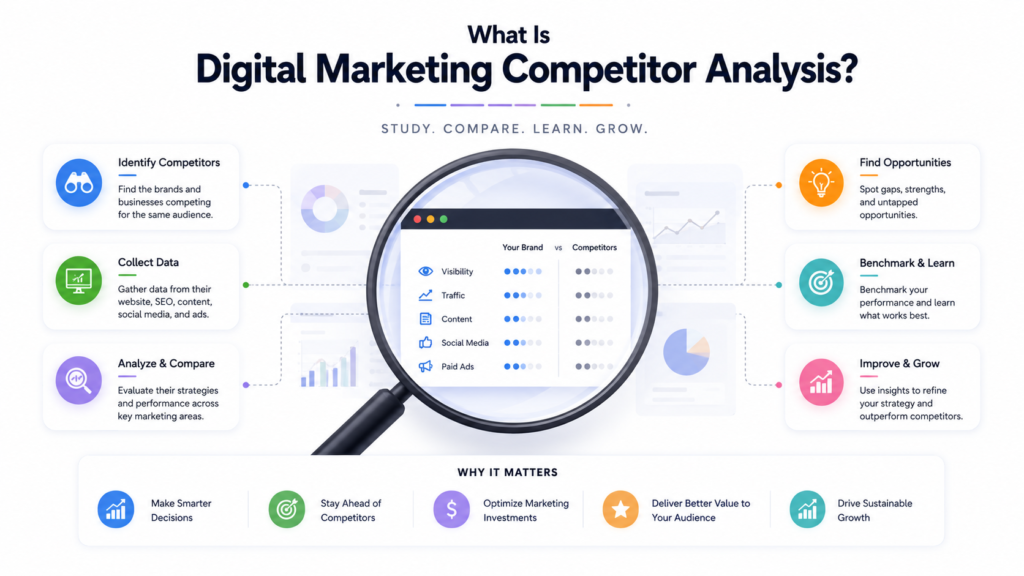
Digital marketing competitor analysis is the process of researching how competing businesses use channels like SEO, social media, content, and local search to reach customers. The goal isn’t to imitate them — it’s to spot what’s working, what’s missing, and where your business has room to stand out.
Done well, it touches almost every part of your marketing: your keyword strategy, your content calendar, your social media approach, and even how you position your Google Business Profile.
Where to Start: Look at the Whole Picture, Not One Channel
When I begin analysing a competitor — say, a local Kochi-based business — the first thing I look at is their overall online presence and target audience. As part of digital marketing competitor analysis, that means checking their website, social media profiles, Google Business Profile, content, and search visibility together, not in isolation.
This gives me a clear starting point. I can quickly see which channels they’re using effectively, what keywords they’re targeting, what kind of content is getting engagement, and where the gaps are — gaps that could become opportunities for my client.
This “whole picture” approach matters more than it sounds. Here’s why.
A Real Example: Why Social Media Isn’t the Whole Story
Not long ago, I performed digital marketing competitor analysis on an online presence of a local business from Kochi by researching their competitor. To do this, I compared their keyword analysis, traffic channels, and content performance using such tools as Google Search, Google Search Console, Google Analytics, and Ubersuggest.
I was surprised by the following thing: the competitor had quite a humble and uninteresting social media profile, yet their website had good rankings in several local search terms. A lot of followers were not a reason of their popularity at all. SEO work and local content played a significant role here.
This discovery changed my views on performing competitor analysis. Had I based my analysis only on social media, I wouldn’t understand what makes a company win its customers.
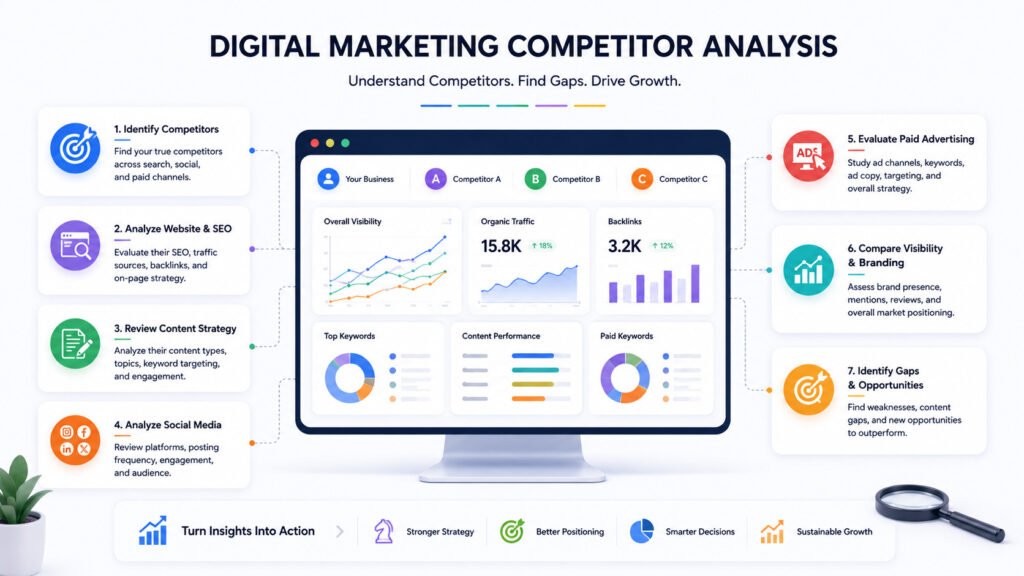
My 7-Step Digital Marketing Competitor Analysis Framework
As I have gained experience, I have developed a process which ensures that the analysis will be practical and useful rather than getting lost in endless surfing on Instagram of the competitors. This is how it looks like:
- Competitors identification – Identify companies that aim at the same audience, geographical area, and services.
- Analysis of their online presence – Analyze their websites, social media channels, Google visibility, and general branding.
- SEO strategy assessment – Analyze the keywords they rank for, content, backlinks, and structure of the website.
- Content and social media assessment – Analyze the type of content they create and its engagement.
- Competitor’s strong and weak points – Identify the best practices and gaps.
- Gaps and opportunities identification – Identify those keywords, topics, channels, or audiences that are not covered by the competitors.
- Development of an action plan.
| Step | Focus Area | What You’re Looking For |
| 1. Identify competitors | Market scope | Businesses with the same audience, location, services |
| 2. Analyse online presence | Website, social, GBP | Overall positioning and channel mix |
| 3. Check SEO strategy | Keywords, backlinks, content | Where they rank and why |
| 4. Review content & social | Engagement | What resonates with the audience |
| 5. Compare strengths/weaknesses | SWOT-style view | Advantages and shortfalls |
| 6. Find gaps | Opportunity mapping | Underserved keywords, topics, platforms |
| 7. Create action plan | Strategy | Concrete next steps for your business |
The goal of this process isn’t to copy competitors. It’s to understand the market well enough to build a stronger, more unique digital marketing strategy than anyone else in your space.
The Biggest Mistake I See Businesses Make
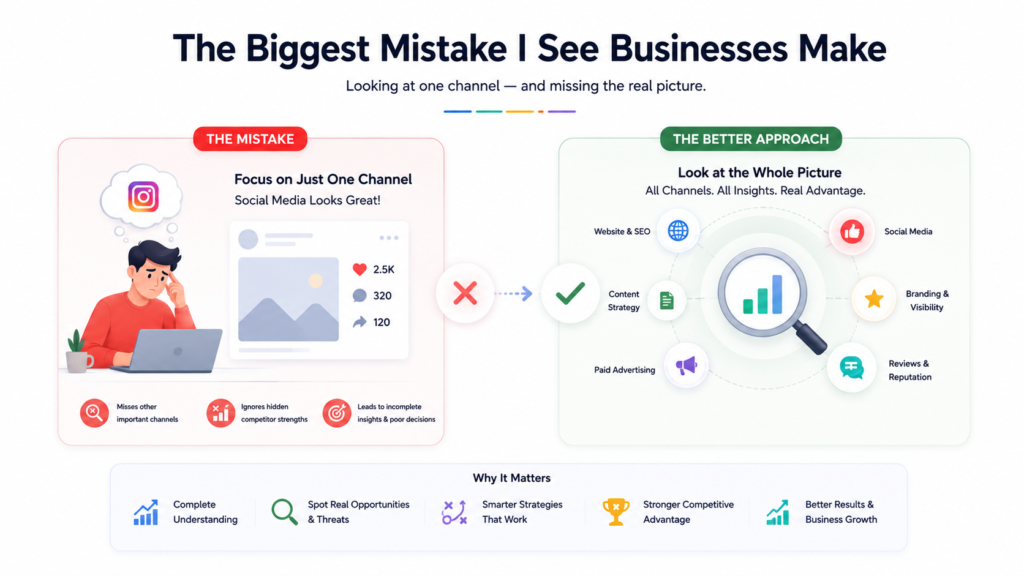
The biggest mistake made while analyzing the competitor is not paying attention to understanding the competitor instead of copying him. The business owner studies the website, social media pages and keywords used by his competitor and tries to replicate them exactly.
However, what’s needed for a successful digital marketing competitor analysis is understanding what a competitor is doing well, where the weak points in their strategy lie, and how you can use those gaps to your advantage. For instance, a business in Kochi may notice that its competitors are targeting the same keywords, yet there’s hardly any local content produced around them — that gap becomes an opportunity.
One Piece of Advice Worth Remembering
But the one thing I would want everyone who reads this to take away is this: do not copy your competitors; instead, figure out what they are missing.
By analysing what competitors do in terms of websites, SEO, social media presence, content creation, and local visibility, it is possible to find those things which they might be overlooking.
This is the core idea behind a digital marketing competitor analysis. If the competitors are ranking well in common keywords but not producing any valuable content for their users in relation to the geographical region, that is the opportunity.
It makes no difference if you are running a café in Kochi, a clinic, or any kind of home services business.
A Quick Note on Limitations
Digital marketing competitor analysis provides direction but not definitiveness. Google Search Console, Google Analytics, and Ubersuggest provide accurate estimations regarding traffic, keywords, and ranks, but statistics may differ among tools, and the real numbers of a competitor, such as actual conversions, ad costs, and cost of acquiring a customer, will always remain unknown for you. Consider competitor analysis as an opportunity to discover trends and possibilities.
FAQs
What is the right frequency of performing digital marketing competitor analysis? Doing so every three to six months is typically sufficient for a local business unless you operate in a rapidly evolving industry or see a competitor take significant actions. A freelance digital marketing analyst in Kochi can help businesses monitor these changes and adjust their digital marketing strategy when needed.
Is it necessary to use paid tools for performing digital marketingcompetitor analysis? Not really. Google Search, Google Search Console, Google Analytics, and Google Business Profile insights will provide you with 80% of the needed information, while Ubersuggest is just a convenient addition.
How many competitors should I analyze in a digital marketing competitor analysis?It is recommended to analyze between three to five competitors to see the patterns clearly without overcomplicating the analysis process.
Conclusion
Digital marketing competitor analysis is not about copying what the competition does; it’s about analyzing the market thoroughly enough to create an opportunity for yourself. By taking a broad view of the entire landscape (not just social media or SEO), by following a systematic approach, and by concentrating on finding gaps instead of imitating competitors, competitor analysis will become the most effective tool of your marketing strategy.
Choose one competitor and follow the seven steps outlined above to perform your own digital marketing competitor analysis and find a gap that only your business can fill.